
Reform of Local Government
Local Democracy is coming? – what it means for Linlithgow
On 21 September, Scottish Government followed earlier commitments to public-sector reform by publishing a paper on the future of local democracy and announced a three-month dialogue period. The earlier discussions happened in 2018 and 2021.
The 2018 response by the Community Council to the Scottish Government consultation stated that Scotland should adopt a three-tier system: Scottish Government → Local Authority → Town/Burgh or Community Council. Linlithgow should have greater authority over decisions that directly affect the town, particularly planning, development and local services. In Linlithgow community views are formally submitted to West Lothian Council and NHSLothian but their influence on planning decisions is unclear. Linlithgow Community Council also lacks meaningful access to Community Planning Partnerships. In the event that services are devolved, such as, community facilities, social housing, street cleaning, parks and gardens then defined local funding would be required for administration and provision. Most importantly, town/burgh councils should operate independently of party politics and focus on consensus to provide community benefits.
The 2021 response to Democracy Matters Phase 2 reinforced the 2018 response reinforcing the argument that local democracy in Scotland remains overly centralised and that communities such as Linlithgow have too little influence over decisions affecting them. Drawing on experience of limited engagement by West Lothian Council, it calls for stronger local decision-making through non-political town/burgh councils, with appropriate powers, funding and staffing. At that time the Community Council was advocating, refurbishment of the Vennel, action on the Victoria Halls gap site, provision of more social and affordable housing, resolution of High St congestion, a comprehensive transport strategy and several other issues.
West Lothian Council has a challenging job to do. It represents communities across nine electoral wards through 33 elected councillors who make policy and budget decisions. West Lothian Council’s approximately 8000 staff are responsible for carrying forward those decisions by administering major local services, including education, social work, housing, roads and planning. The council tries to undertake this task equitably without favour to any one community. Unfortunately, this one community view of West Lothian leads to unique problems in any one community such as Linlithgow, being overlooked.
The current consultation carries forward the previous Democracy Matters consultations with more detailed suggestions to reduce the number of public bodies. The proposal is to transform the existing 32 local authorities into 6-10 regional authorities, and 120-160 community authorities. The number of elected councillors would remain the same, with some serving on both regional and local authorities. The proposed outline split of responsibility is:
Regional Authorities
- housing, with some functions and responsibility shared with More Homes Scotland
- strategic planning, alongside a national planning hub
- employability support, aligned to economic development and skills with the potential for greater national commissioning and/or coordination
- relevant areas of transport, including Regional Transport Partnerships and potentially some functions currently with Transport Scotland
- environmental services such as waste and cleansing
- civil defence, resilience and response, shared with national government
- provision of regulatory services
- early learning and education with some elements potentially directed more locally by community authorities
Community Authorities
- planning, commissioning and delivery of joined up, community-based support that is person-centred and responsive to local need, including Whole Family Support
- householder planning applications
- community planning
- licensing decisions
- management of the historic environment and open space and greenspace
- regeneration of local town centres
- provision and maintenance of local leisure, sport and culture facilities.
The proposal states that this would “improve local decision making” while also delivering efficiency.
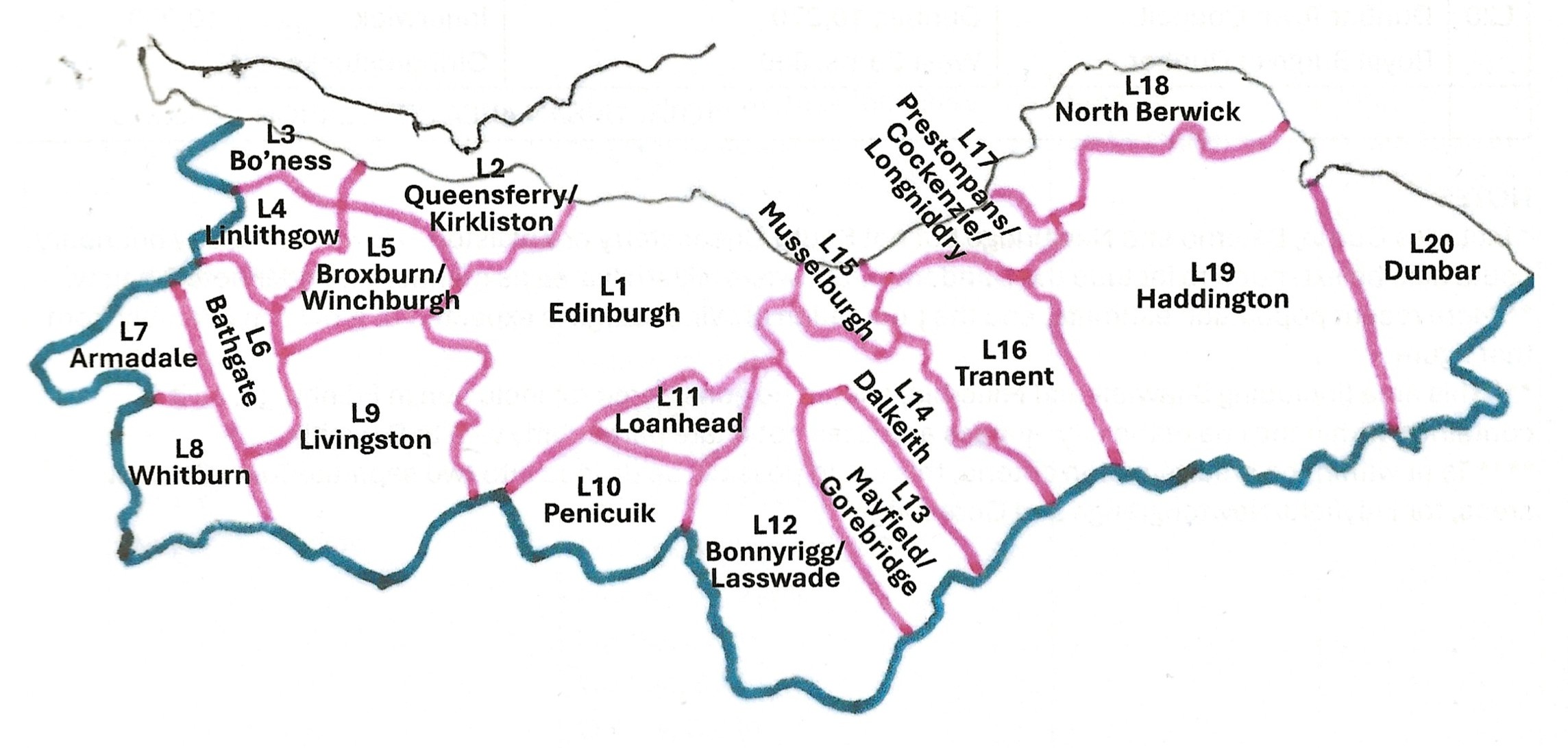
The main question arising from this proposal is one of practicability, is it feasible to divide Scotland into 10 regional authorities and 160 community authorities? Ron Smith, Civic Trust member of the Planning Forum and associate member of the Community Council used his cartographic and town planning experience to answer that question. His paper is on the Community Council website. Ron’s suggestion is 10 regional councils plus a separate council for Western Isles, Orkney and Shetland, 172 community authorities based on populations of about 10,000 to 20,000 plus four city authorities.
The model is found to work well for all different types of existing, recognised communities or groups of communities, ranging between single towns or cities (large or small), towns serving numerous smaller places, groups of small towns and more sparsely populated rural areas. The suggestion ensures that the council areas selected are readily identifiable and would give people a sense of belonging.
Would it work for Linlithgow – absolutely!
The final question is would this be the end of Community Councils and the answer to that is probably yes in their current form. There are approximately 1200 Community Councils in Scotland with the primary remit of to ascertaining, co-ordinating and reflecting the views of the community which it represents and expressing the views of the community to the local authority for the area and to other public authorities and organisations. Linlithgow and Linlithgow Bridge Community Council is a voluntary organisation elected by local residents on a four-year cycle, funded by a grant of approximately £1000 per annum, and does its best to voice the views of the community. The extent to which West Lothian Council, NHSLothian and other organisations take any notice of those views is debatable. What comprises a community authority has yet to be decided but irrespective of its constitution a Linlithgow Burgh Council has a lot to recommend it.
A full version of this report can be found here: https://drive.google.com/file/d/1iN6Piol7aXnxF0xUpcVHq8WawK1xepn5/view